
Aerial Lift Safety Training Barrie
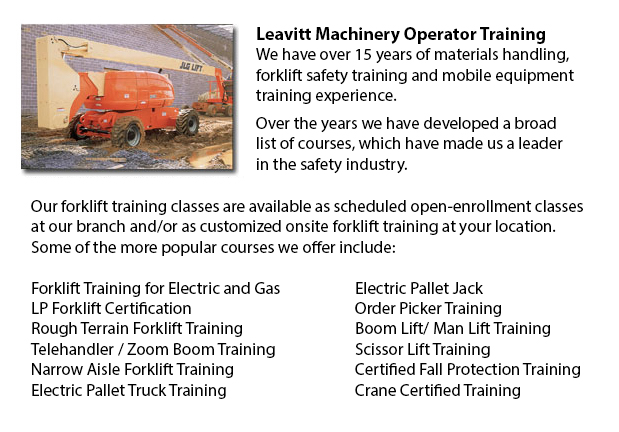

Aerial Lift Safety Training Barrie - There are around 26 to 30 construction fatalities in North America attributed to the utilization of aerial lifts. Most of those killed are craftsmen like for instance laborers, painters, electrical workers, ironworkers or carpenters. Most deaths are caused by falls, tip-overs and electrocutions. The greatest risk is from boom-supported lifts, such as bucket trucks and cherry pickers. Nearly all fatalities are connected to this particular type of lift, with the rest involving scissor lifts. Other risks include being thrown out of a bucket, being struck by falling things, and being caught between the guardrail or lift bucket and a thing, like a joist or steel beam.
To operate an aerial lift safely, perform a check on the following things prior to making use of the device: operating and emergency controls, safety devices (like for instance, outriggers and guardrails), personal fall protection gear, and wheels and tires. Check for possible leaks in the air, fuel-system, hydraulic fluid. Inspect the device for missing or loose parts.
The places where worker will make use of the aerial device should be inspected thoroughly for possible hazards, like for example bumps, holes, drop-offs and debris. Overhead powerlines have to be avoided and monitored. It is recommended that aerial lift devices be utilized on level, stable surfaces. Do not work on steep slopes that go beyond slope limits that the manufacturer specified. Even on a slope that is level, outriggers, brakes and wheel chocks should be set.
Businesses should provide their aerial lift operators with the correct instruction manuals. Operators and mechanics must be trained by a qualified person experienced with the applicable kind of aerial lift.
Aerial Lift Safety Tips:
o Before operating, close doors and lift platform chains.
o Climbing on and leaning over guardrails is prohibited. Stand on the floor of the bucket or platform.
o Use the provided manufacturer's load-capacity restrictions.
o Make use of work-zone warnings, like for example signs and cones, when working near traffic.
If proper procedures are followed, electrocutions are preventable. Stay at least ten feet away from whichever power lines and qualified electricians should insulate and/or de-energize power lines. Workers should make use of personal protective tools and equipment, like for example insulated bucket. Then again, a bucket which is insulated does not protect from electrocution if, for example, the worker touches another wire providing a path to the ground.
Falls are preventable if the individual working remains secure within guardrails or in the bucket by making use of a full-body harness or a positioning device. If there is an anchorage within the bucket, a positioning belt with a short lanyard is adequate.
By following the manufacturer's directions, tip-overs could be prevented. Never drive the lift platform while it is elevated, unless otherwise specified by the manufacturer. Adhere to the vertical and horizontal reach limitations of the device, and never exceed the specified load-capacity.

-
Order Picker License Barrie
Order Picker License Barrie - Order picking is likewise called order preparation operation. This is one of the chief processes in a warehouse and consists of people referred to as order pickers, collecting and taking articles in a certain quantity be... More -
Overhead Crane Safety Training Barrie
Overhead Crane Safety Training Barrie - The overhead crane safety training program is designed to equip the operators with the right knowledge and skills in the areas of: crane safety measures, accident avoidance, materials handling, and equipment an... More -
Warehouse Forklift Training Programs Barrie
Warehouse Forklift Training Programs Barrie - Warehouses can either be commercial, retail or industrial facilities, functioning from product distribution services to bulk product retailing. Regardless of the type of warehouse, employees in warehouse... More -
Forklift Training Program Barrie
Forklift Training Program Barrie - The lift truck is a common powered industrial vehicle which is in wide use today. They are sometimes referred to as hi los, lift trucks or jitneys. A departments store will utilize the forklift to be able to load an... More -
Overhead Crane Ticket Barrie
Overhead Crane Ticket Barrie - An overhead crane is usually used in industrial settings. Likewise referred to as a bridge crane, this particular machinery includes parallel runways spanned by a traveling bridge. The hoist is the part that lifts mater... More -
Forklift Training Classes Barrie
Forklift Training Classes Barrie - Lift truck are heavy pieces of industrial machines which are utilized in the handling and transporting of materials and merchandise. They are often referred to as Lift trucks and are found in all sorts of businesses... More -
Crane Training Schools Barrie
Crane Training Schools Barrie - Our different Mobile Crane Operation programs are intended for experienced operators who requires certification or re-certification, and for inexperienced individuals who are searching for their first job as an operato... More -
Forklift Instructor Training Barrie
Forklift Instructor Training Barrie - For those forklift operators who would like to become a lift truck instructor it is recommended that they complete a forklift Instructor training certification course. Entry qualifications for the forklift instru... More

Forklift Training Barrie

TOLL FREE: 1-888-254-6157
Barrie, Ontario
forklifttrainingbarrie.com
Email Us
About Us