
Rough Terrain Forklifts
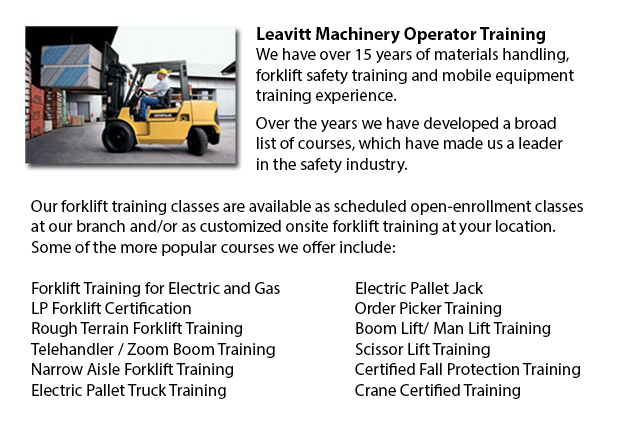

Rough Terrain Forklifts Training Barrie - There are essentially two categories of lift trucks within the production industry, the rough terrain model and the industrial model. Rough terrain forklifts appeared in the 1940’s built primarily for use on uneven surfaces, ideal for lumberyards and building sites, offering hauling muscle when there was no paved surface available.
Typically, the majority of rough terrain lift trucks are run on a propane, diesel or gas driven internal combustion engines with a battery used for power. Many manufacturers are experimenting with rough land lift trucks that consume vegetable matter and run from ethanol. Large pneumatic tires with deep treads typify these vehicles to allow them to grab onto the roughest soil type devoid of any misstep or drifting.
The most primitive versions of rough terrain lift trucks were able to transport weights of up to 1000 lbs, with forks that could run under the item, jack it a little bit and then transfer it to an alternate location. After some time on the market, rough terrain lift trucks were given supplementary carrying power to about 2000 lbs capacity. Telescoping booms were added in the 1960’s, enabling them to stack resources a great deal higher than in earlier years. The telescoping model feature is a staple of most rough terrain forklifts at the moment. Present versions are capable of handling well over 4000 lbs due to the constant improvements over time. Telescoping capability has also improved with some styles attaining a height of 35 feet. Operator safety has also become a focus with a lot of all terrain lift trucks currently designed are equipped with an enclosed cab for the driver, as opposed to the older open air seating capacity.
The all terrain lift trucks on the market today both function skillfully on unpaved roads and paved floors. This kind of all terrain lift truck is marketed for its’ usefulness permitting the opportunity for businesses to utilize one unit to carry resources from an outside working site into a warehouse.

-
Genie Forklift
Genie Forklift Training Barrie - Genie Industries prides itself with the notion of lifting individuals and resources higher, extending beyond the products they manufacture. A worldwide corporation that is deeply associated to their customers and enjo... More -
Komatsu Forklift
Komatsu Forklift Training Barrie - Komatsu Forklift U.S.A. Inc., an affiliate of the Komatsu Ltd. family, has an affirmative reputation for building rugged and reliable forklifts. They are renowned globally as a corporation who has a proud heritage a... More -
Scissor Pallet Trucks
Scissor Pallet Truck Training Barrie - Scissor lift pallet trucks are designed to be able to transport and stack pallets with a built-in lifting apparatus that allows the pallets to be elevated. This apparatus is very valuable for working in limited... More -
Boom Trucks
Boom Trucks Training Barrie - Boom vehicle are often used by phone, cable television and utilities organizations as they have long folded arms which are commonly folded over the roofs of business vehicles. On the end of the extension of extendable ar... More -
Boom Lifts
Boom Lifts Training Barrie - Boom lifts are equipment that has a platform that can be lowered or lifted to a range of heights, therefore making this piece of equipment an important requirement in a wide variety of professions. Available in many diffe... More

Forklift Training Barrie

TOLL FREE: 1-888-254-6157
Barrie, Ontario
forklifttrainingbarrie.com
Email Us
About Us